The saga of Digg, one of the internet’s most storied brands, has entered its latest chapter. Following a failed attempt to capture the social forum market earlier this year, founder Kevin Rose has officially unveiled a radical redesign of the platform. The new iteration abandons the "Reddit-clone" ambitions that led to a March shutdown, opting instead to return to its roots as a sophisticated news aggregator, specifically tailored to the fast-moving landscape of artificial intelligence.
The reboot, currently in an experimental beta phase, signals a fundamental shift in strategy for the startup. By leveraging real-time data from social media giant X, the new Digg aims to function as a signal-to-noise filter for a digital era overwhelmed by AI-generated content and automated bot traffic.
A Chronology of the Recent Rebirth
The timeline of Digg’s recent turbulence illustrates the volatility of the current social media ecosystem. In June 2025, the brand underwent a significant reboot, positioning itself as a direct competitor to Reddit. The goal was to build a community-driven forum that could capture the energy of decentralized, user-led discussions.
However, the experiment struggled from the outset. By January 2026, the company officially launched its public interface, but by March 2026, the project hit a wall. Internal reports noted that the platform was inundated with bot-driven activity, which effectively diluted the quality of human conversation and engagement. Furthermore, the platform failed to distinguish itself enough from established incumbents like Reddit, which possess deeper user bases and more entrenched community moderation tools.
In mid-March, Digg underwent a significant staff reduction and suspended its application services to "go back to the drawing board." Kevin Rose, who serves as a partner at the venture capital firm True Ventures, assumed a full-time role in April to oversee the platform’s pivot. By Friday evening, the founder provided the first public glimpse into the new, AI-focused architecture of the site.

The New Architecture: Data-Driven Curation
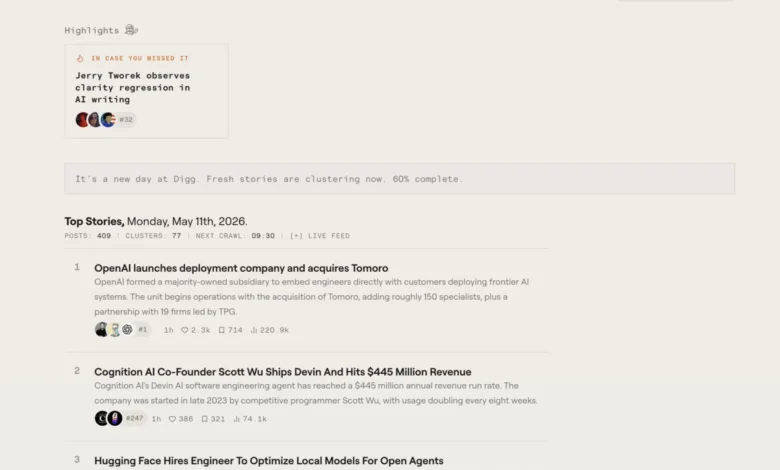
The current iteration of Digg is less of a community forum and more of a real-time analytics dashboard. The homepage is now organized around four primary metrics that define the hierarchy of information: the most viewed story, a story witnessing a surge in discussion, the fastest-climbing narrative, and a "In case you missed it" selection.
Crucially, the site does not rely on its own internal user engagement to rank these stories. Instead, it utilizes an ingestion engine that pulls data from X in real-time. By applying sentiment analysis, cluster identification, and signal detection, the platform purports to identify the most significant developments in the AI sector before they hit mainstream headlines.
Rose, writing on X, underscored the logic behind this move: "When leaders like Sam Altman engage with specific discourse, it creates a ripple effect of engagement. Our goal is to track that chain reaction." The platform is not merely indexing headlines; it is tracking the velocity of influence, effectively mapping the "top 1,000" voices in the AI space, along with the most active companies and policymakers currently shaping the industry.
Market Context and Strategic Challenges
While the shift to an AI-focused aggregator provides a clear niche, it raises questions regarding long-term viability. The modern information landscape is fractured; users are increasingly turning to dedicated newsletters, specialized RSS aggregators, and vertical-specific platforms for their news.
One of the primary obstacles for this new iteration of Digg is the lack of internal community discussion. While the site effectively displays what is being discussed elsewhere, it does not currently host the discourse itself. In a web environment where users are increasingly wary of "dead internet" theory—the idea that the internet is becoming populated mostly by bots and automated content—the absence of authentic, human-led community interaction may limit the platform’s stickiness.
Furthermore, the reliance on X as a primary data source presents a strategic dependency. Since Elon Musk’s acquisition of the platform, the dynamics of X have shifted significantly. The rise of alternative platforms such as Meta’s Threads, alongside a general migration of users away from open public forums toward private, encrypted channels (like Discord or Telegram), means that any news aggregator relying solely on X may miss significant portions of the broader cultural conversation.

Implications for the Digital Publishing Ecosystem
Despite these hurdles, there is a potential silver lining for digital publishers. The current state of online search is in crisis; recent data suggests that the implementation of AI Overviews in search engines has significantly reduced click-through rates for independent websites. As Google and other search providers prioritize in-engine summaries, publishers are finding it harder than ever to attract traffic.
If the new Digg can successfully position itself as a trusted curator of high-quality, human-written content, it could theoretically become a vital source of referral traffic for publishers. By surfacing the "most influential" stories rather than just the most viral, Digg may offer a lifeline to long-form journalism and in-depth reporting that is currently being buried by algorithms that favor quick, AI-generated snippets.
Official Stance and Future Outlook
In communications sent to beta testers, the company acknowledged that the platform remains "raw" and "buggy." The current release is strictly intended for first-look testing rather than a full-scale public launch. The company’s stated goal is to provide a tool that helps users navigate the "noise" of the internet, with AI serving as the initial testing ground for this methodology.
If this curation model proves successful, the company plans to expand into other verticals. However, the move away from the community-driven model is a clear acknowledgment that the "Reddit-style" forum era of the early 2010s is likely not the path forward for a brand trying to reclaim its relevance in the mid-2020s.
The success of this reboot will likely depend on the platform’s ability to prove its value beyond mere data visualization. While "data nerds" may appreciate the charts and graphs documenting the rise of an AI-related headline, the average consumer will likely require a more seamless integration into their daily workflow. Whether this means adding a native discussion layer, integrating personalized feed options, or partnering with publishers for direct content distribution remains to be seen.
Summary of Strategic Pivot
- The Problem: The previous version of Digg faced high bot traffic, an oversaturated market of Reddit-clones, and a lack of meaningful differentiation.
- The Solution: A pivot to AI-driven, data-backed news aggregation that relies on real-time social signal analysis rather than internal community votes.
- The Risks: Heavy reliance on X as a data source, a lack of original on-site discourse, and the challenge of competing with established news aggregators and personalized AI news feeds.
- The Opportunity: By acting as a filter, Digg could regain its status as a trusted curator, potentially driving traffic back to reputable publishers who are currently suffering from declining search engine visibility.
As Digg continues to refine its interface and expand its tracking capabilities, the tech industry will be watching closely. Whether this represents the final iteration of a legendary brand or another experimental phase in its long, winding history remains an open question. For now, the "new" Digg is a test of whether a brand can successfully reinvent itself by turning the chaos of the social web into a structured, analytical feed of what truly matters.